
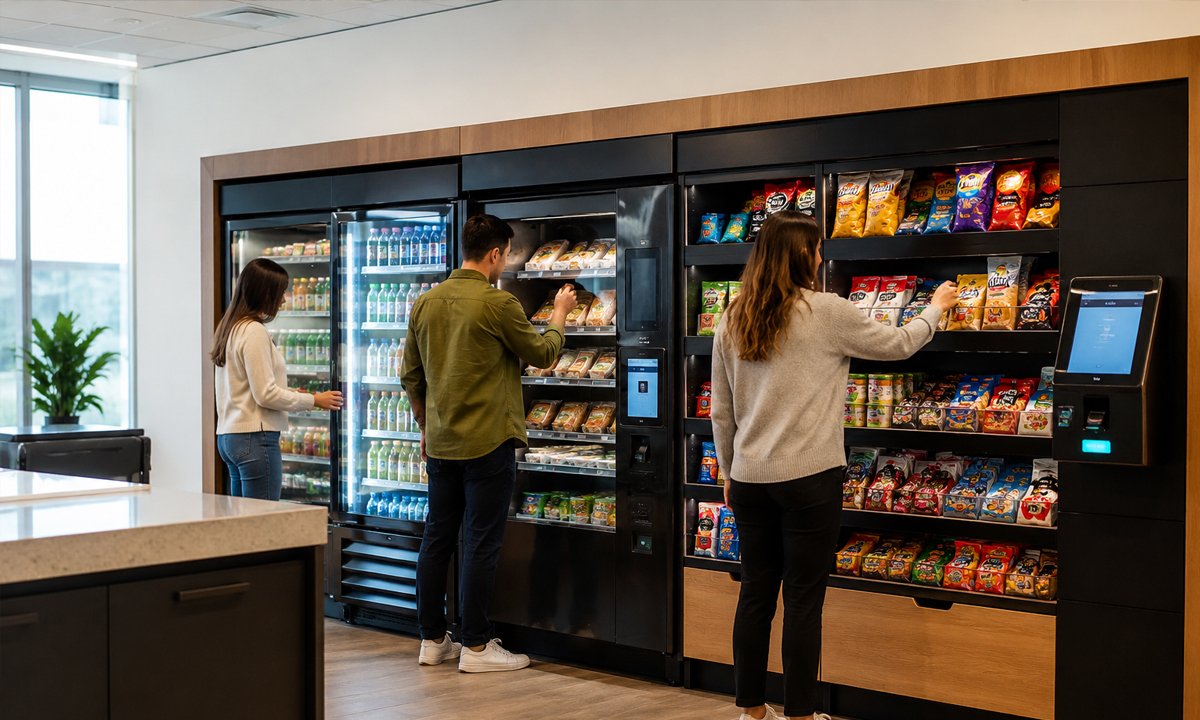
Workplaces are evolving faster than ever, and one of the most noticeable changes is how employees access food and beverages during the workday. What was once a basic convenience has now become a critical part of workplace design, employee satisfaction, and productivity strategy.
Traditional vending machines and staffed cafeterias are no longer enough to meet modern expectations. Employees want speed, flexibility, and 24/7 availability without delays or limitations. This is where the smart store model is becoming essential.
A smart store is an automated retail environment built for workplaces. It uses artificial intelligence, sensors, and digital payment systems to create an unattended retail experience. Employees simply pick what they need and leave, while the system handles tracking, billing, and inventory in real time.
This model is reshaping workplace food services, modern office breakroom design, and the broader category of smart retail solutions across industries.
The Shift From Traditional Breakrooms to Smart Retail Systems
Workplace food services have gone through multiple stages of evolution. From basic vending machines to cafeterias and pantry services, each model has attempted to solve convenience and access. However, modern workplace demands require something more advanced.
Organizations are now shifting toward smart food service models that rely on automation and data intelligence rather than manual operations.
Traditional systems often struggle with:
- Limited access hours that restrict employee convenience
- High staffing and maintenance costs
- Inconsistent inventory tracking and replenishment
- Food waste caused by poor demand forecasting
- Slow service during peak break periods
Smart stores solve these problems by replacing manual processes with automated systems that operate continuously.
According to Insights from Wikipedia on Retail Technology, retail environments have transformed through automation, digital payments, and intelligent tracking systems. These same innovations are now being applied inside workplaces through modern breakroom ecosystems.
Companies like January Service Company are implementing this transformation through their smart store solution, which brings unattended retail directly into office environments, improving both efficiency and employee experience.
Why Smart Store Systems Are Becoming Essential
The growing adoption of smart stores is driven by real operational and workforce needs, not just technology trends.
Key factors include:
- Employees expect instant access to food and beverages
- Hybrid and shift-based work requires 24/7 availability
- Organizations need tighter cost and inventory control
- Employee experience is directly linked to retention
- Data-driven decision-making has become standard practice
A smart store addresses all these needs by combining automation with real-time intelligence. It transforms a basic office breakroom into a fully optimized retail environment.
The idea of digital transformation, widely explored in Harvard Business Review’s digital transformation insights, emphasizes how organizations that adopt digital systems outperform those relying on manual workflows. Smart stores are a physical extension of this transformation inside workplace environments.
This is also where frictionless shopping becomes critical. Employees no longer wait in line or interact with checkout staff. Instead, the entire process is automated, saving time and improving convenience.
How Smart Store Technology Works in Real Workplaces
Smart stores operate through a combination of AI, IoT, and automated retail systems designed to eliminate manual processes.
Core technologies include:
- Sensor-based or AI-powered product recognition systems
- Automated billing and checkout mechanisms
- Cloud-based inventory tracking dashboards
- Predictive analytics for demand forecasting
- Cashless and mobile payment systems
Together, these components create a seamless smart retail solutions environment where employees can shop without interruption while the system manages operations in the background.
This aligns with advancements in artificial intelligence governance and applied systems research. The National Institute of Standards and Technology (NIST) emphasizes the importance of building reliable and transparent AI systems that perform consistently in real-world applications.
Smart stores follow similar principles by ensuring accurate billing, reducing errors, and improving operational transparency.
To support these systems, January Service Company integrates AI and IoT through its broader technology infrastructure, connecting workplace food systems into a unified digital ecosystem.
Impact on Employee Experience and Workplace Culture
One of the strongest advantages of smart stores is their impact on employee experience.
Modern employees value convenience as much as compensation in many workplace environments. When food access becomes seamless, it directly improves productivity and satisfaction.
Smart stores improve workplace experience by:
- Offering instant access to food and beverages
- Eliminating queues and waiting time
- Providing 24/7 availability for all work shifts
- Expanding product variety beyond traditional vending
- Supporting hybrid and flexible work schedules
Unlike traditional office breakroom setups, smart stores feel dynamic and responsive. Employees are no longer restricted by fixed service hours or limited options.
This shift also influences workplace culture. Companies that invest in modern breakroom solutions signal a commitment to employee well-being, which improves morale and retention over time.
Industry discussions on workplace modernization, such as why offices prefer micro-market services today, highlight how self-service systems enhance both engagement and operational efficiency.
Smart Stores vs Traditional Workplace Food Models
To understand why smart stores are becoming essential, it is important to compare them with traditional workplace food systems.
Traditional models rely heavily on vending machines or staffed cafeterias. While effective in the past, they come with clear limitations.
Traditional systems are:
- Restricted by operating hours
- Dependent on staffing and manual restocking
- Slower in serving employees
- Limited in data visibility and tracking
- Difficult to scale efficiently
Smart store systems, on the other hand, are:
- Fully automated and always available
- Designed for frictionless shopping experiences
- Powered by real-time analytics and AI
- Scalable across multiple workplace sizes
- Highly efficient in inventory and cost management
This clear difference explains why many organizations are upgrading from legacy systems to modern smart food service environments.
Strategic Importance of Smart Stores in Modern Workplaces
Smart stores are no longer just convenience tools. They are becoming strategic assets in workplace planning and organizational development.
Companies use them to achieve several goals:
- Improve employee retention through better workplace amenities
- Reduce downtime caused by off-site food breaks
- Strengthen employer branding in competitive job markets
- Support hybrid, remote, and shift-based workforce models
- Improve operational efficiency through automation
When integrated with other workplace food services, such as coffee systems, hydration stations, and pantry services, smart stores become part of a complete workplace ecosystem.
This ecosystem is designed not only for convenience but also for long-term operational intelligence and employee satisfaction.
The Future of Smart Store Systems in Workplaces
The future of workplace food services is clearly moving toward automation, intelligence, and personalization. Smart stores are at the center of this transformation because they combine physical infrastructure with digital intelligence.
Three key trends will shape the future:
- Expansion of unattended retail across workplaces
- Increased use of AI for predictive inventory management
- Growth of cashless and frictionless workplace environments
As these trends continue, smart stores will become a standard workplace feature rather than an innovation.
Organizations that adopt early will benefit from improved efficiency, better employee experience, and stronger operational control. Those that delay may struggle to meet rising workplace expectations.
Conclusion
Smart store systems are becoming essential in modern workplaces because they solve the limitations of traditional food service models. By combining automation, artificial intelligence, and real-time analytics, they create a seamless and efficient environment for employees.
They improve access, reduce operational friction, and enhance workplace culture. More importantly, they align with the broader shift toward digital transformation in physical environments.
As workplaces continue to evolve, smart stores will not just support the future of workplace food services and office breakroom systems. They will define how organizations deliver convenience, efficiency, and employee satisfaction in the years ahead.