
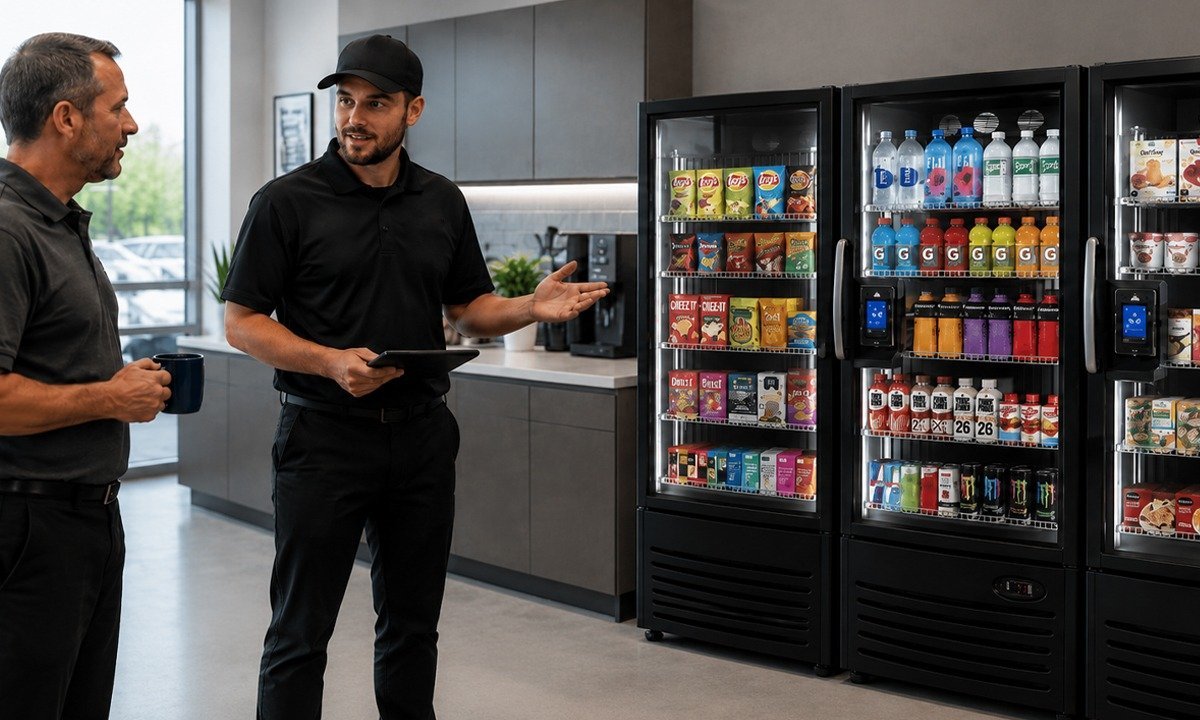
A jammed vending machine at 10 a.m. is not a crisis. It is an inconvenience, right up until it happens for the third time in a month and employees start bringing their own snacks from home because they have simply stopped trusting the machine. That slow erosion of trust is the real cost of poor breakroom service, and it is a cost most facility managers only notice after it has already shaped how their team feels about the workplace.
This is where the difference between a national vending contract and a local vending company becomes obvious. On paper, both promise stocked machines and working equipment. In practice, one of them can have a technician standing in front of the broken unit within a few hours, and the other is routing a support ticket through a call center in another state. When a business depends on its breakroom to keep people fed, caffeinated, and productive through a long shift, that gap in speed is not a small detail. It is the whole ballgame.
Why Speed Is the Real Differentiator in Breakroom Solutions
Most companies evaluate breakroom solutions based on machine variety, product selection, and pricing. Those things matter, but they rarely determine whether an employee has a good or bad experience with the breakroom on any given day. What determines that is whether the coffee machine gets fixed before the afternoon rush, whether a jammed vending slot gets cleared before lunch, and whether the person handling the repair actually knows the equipment on-site.
Peer-reviewed research on service recovery backs this up directly. A study published on the National Institutes of Health’s research database found that responsiveness, meaning the willingness to help customers and deliver prompt service, is one of the strongest predictors of overall customer satisfaction across service industries. That finding was not written with vending machines in mind, but it applies just as well to a breakroom as it does to a hotel front desk or a hospital waiting room. People remember how quickly a problem got solved far more than they remember that the problem happened at all.
This is exactly why quick support matters more than most procurement checklists give it credit for. A vendor who answers the phone and shows up matters more, long term, than one who quoted a slightly lower price per unit but takes two days to send a technician.
What “Vending Machine Service Near Me” Actually Means for Businesses
When facility managers search for vending machine service near me, they are usually not just looking for proximity on a map. They are looking for a provider who can realistically respond the same day, who stocks common replacement parts locally instead of ordering them from a distant warehouse, and who has technicians already familiar with the specific machines installed on-site.
A regional or national vendor may technically serve a metro area, but their nearest service hub could still be a few hours away, and their technicians may rotate across dozens of accounts they have never seen before. A locally based provider, by contrast, tends to build long-term familiarity with each account. The technician who shows up already knows which coin mechanism on that particular smart store jams in humid weather, or which coffee brewer at that office needs its water line flushed more often. That kind of institutional knowledge cannot be replicated by a call center reading from a script.
Research from Harvard Business School on organizational agility makes a related point on a broader scale. It found that companies able to act and adapt quickly build a durable competitive advantage over slower-moving competitors, even when those competitors have more resources. The same logic scales down to a single breakroom vendor relationship. A smaller, local operator that can move fast is often a better long-term partner than a larger company weighed down by layers of approval and dispatch.
The Hidden Cost of Slow Vending Machine Maintenance
Delayed vending machine maintenance rarely shows up as a line item on a budget report, but it shows up everywhere else. Lost product sales from a machine that sat empty for three days add up. So does the time an office manager spends fielding complaints instead of doing their actual job. And so does the quieter cost of employees simply giving up on the breakroom altogether and driving off-site for lunch, which chips away at productivity in a way that is hard to measure but easy to feel.
Regular maintenance also affects food safety and equipment lifespan, not just convenience. Machines that are not serviced on schedule are more likely to develop refrigeration issues, jammed coils, or payment system failures, all of which compound the longer they go unresolved. A provider who treats maintenance as reactive, only responding after something breaks, is setting a business up for repeated disruptions rather than solving the pattern underneath them.
This is one of the reasons full-line vending programs work best when they are paired with a genuine service commitment rather than just equipment placement. The machines themselves are only half of the equation. The other half is what happens the moment something goes wrong, a topic we cover in more depth in our piece on breakroom solutions for warehouses with multiple shifts, where downtime affects far more people at once.
Choosing a Vendor Who Treats Problems as Priorities
Forbes has pointed out that the way a vendor handles the sales process is often a preview of how they will handle problems after the contract is signed. A slow, generic response during the sales conversation is rarely a fluke. It tends to be the pattern that continues once the ink is dry.
This is a useful filter for any business evaluating breakroom solutions. Ask direct questions before signing anything. How fast is the average response time to a service call? Is that response backed by a written guarantee, or is it just a verbal promise? Does the technician who arrives actually work for the company, or are they subcontracted from a third party with no direct accountability?
Businesses that have already gone through this evaluation process often share what mattered most to them once the contract was signed. Our recent article on what Memphis businesses look for in a reliable vending provider breaks down the specific criteria that separated the vendors employees actually trusted from the ones that generated ongoing complaints.
Why Self Service Micro Markets Raise the Stakes on Responsiveness
The shift toward self service micro market setups has changed what businesses expect from their vending partner. Unlike a traditional vending machine, a micromarket includes open shelving, refrigerated cases, and a self-checkout kiosk, which means there are simply more components that can go wrong at once. A payment terminal glitch can stop every transaction in the market until it is resolved, not just block one product slot.
That added complexity makes fast, local support even more important than it was with standalone machines. A provider who understands the technology behind a self-serve micromarket and can troubleshoot it in person, rather than walking a facility manager through a phone-based reset, prevents a minor glitch from turning into a half-day outage. For companies weighing whether to upgrade from vending to a micromarket, this is one of the most overlooked factors. The technology is only as good as the team standing behind it when something breaks.
The Bottom Line for Facility and Office Managers
Choosing a breakroom provider based purely on price per snack or the size of a product catalog misses the factor that actually shapes daily employee experience: how fast problems get solved. A jammed machine, an empty coffee brewer, or a frozen payment kiosk are not major disasters on their own, but left unresolved for even a day or two, they quietly erode trust in the workplace and push employees to look elsewhere for their break.
Local providers tend to win this comparison not because of sentiment or a “shop local” preference, but because proximity translates directly into speed, familiarity, and accountability. When evaluating any breakroom partner, the right question is not just what they offer, but how quickly they show up when something goes wrong, and whether that promise is backed by more than a sales pitch.