
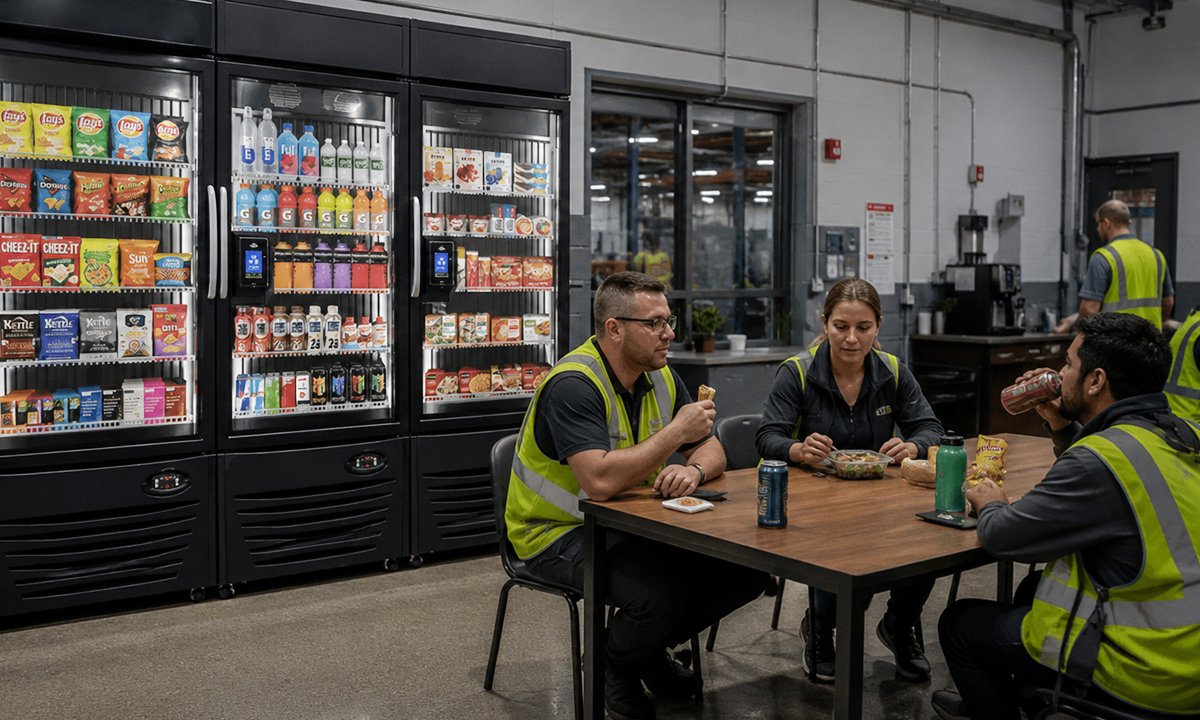
Warehouses rarely operate on a traditional 9-to-5 schedule. Many distribution centers run two or three shifts, while some operate around the clock, including weekends and holidays. That creates a simple challenge: employees need reliable access to food, drinks, and refreshments whenever they take a break.
A breakroom designed around the first shift does not serve the entire workforce. Employees working evenings, overnight, or weekends need the same convenience as day-shift employees.
The right breakroom solutions can help warehouses create a more consistent employee experience. Modern vending, pantry programs, hydration options, and self-service technology can keep refreshments available without requiring a staffed cafeteria.
Why Multiple Shifts Need Different Breakroom Solutions
A warehouse with multiple shifts has a different operating rhythm from a typical office. Day-shift employees may have nearby restaurants, coffee shops, and convenience stores, while overnight and weekend employees may have fewer options.
The CDC’s National Institute for Occupational Safety and Health notes that nonstandard schedules, including night work and extended hours, can contribute to workplace fatigue and affect attention, concentration, reaction time, memory, and judgment.
Refreshments do not solve fatigue on their own. However, employers can remove unnecessary barriers during breaks by making food and beverages easy to access. Research published in the International Journal of Nursing Studies also found associations between shift-work characteristics and employee performance and well-being, with timely breaks having a positive effect on fatigue and alertness.
A well-planned breakroom supports those breaks by keeping basic refreshments available when employees need them.
What Should a Warehouse Breakroom Provide?
The best workplace refreshment solutions start with the workforce rather than the equipment. A warehouse may need snacks, beverages, fresh food, coffee, water, and other everyday essentials.
A practical warehouse breakroom may include:
- Cold beverages and bottled water
- Coffee and hot beverages
- Snacks for short breaks
- Fresh meals for longer shifts
- Healthier snack options
- Refrigerated food and drinks
- Cashless payment options
- Reliable restocking and maintenance
- Easy access during nights and weekends
Product selection should also reflect the work environment. Employees working long physical shifts may prefer more substantial food choices. Managers can review purchasing patterns and employee feedback to identify what different shifts actually want.
Vending Services for Warehouses With Multiple Shifts
Traditional vending services remain a practical option for warehouses because machines require relatively little space and can provide food and drinks throughout the day.
The key is service reliability. A machine that is fully stocked for the first shift but empty by the overnight shift provides limited value.
Useful factors to monitor include:
- Sales by product and time of day
- Inventory levels
- Shift schedules
- Product preferences
- Machine performance
- Restocking frequency
Modern systems can make this process easier by providing sales and inventory information. January Service Company provides managed Vending Services in Memphis with options for snacks, beverages, fresh food, healthier choices, cashless payments, restocking, maintenance, and ongoing support.
Why Smart Vending Machines Can Help
Warehouses with several shifts can benefit from smart vending machines because they provide greater visibility into machine activity.
Suppose the overnight shift regularly purchases bottled water and protein-based snacks. Purchasing data can help a service team adjust inventory around that demand.
Smart vending can also support cashless payments, allowing employees to purchase refreshments without carrying cash.
For facility managers, sales and inventory information can reveal demand patterns and improve replenishment decisions. Technology should support the service rather than replace reliable maintenance and restocking.
Cashless Vending Machines Make Breaks More Convenient
Employees often have limited time during a scheduled break. A slow or complicated purchasing process can take away from that time.
Cashless vending machines can simplify transactions by supporting card or mobile payments. This is especially useful in warehouses where employees may not carry cash while working.
Hydration Should Be Part of the Plan
Water access deserves special attention in warehouse environments. Employees may work in physically demanding areas, and some facilities may experience higher temperatures or limited climate control.
OSHA’s sanitation standard requires potable drinking water in places of employment and includes requirements for the sanitary design and servicing of portable drinking-water dispensers. Read the full OSHA 1910.141 Sanitation Standard when reviewing workplace requirements.
Pantry Services Can Expand Breakroom Options
Not every warehouse needs to rely on vending alone. A pantry program can provide additional snacks, beverages, and employee amenities throughout the workday.
Office Pantry Service in Memphis can complement other refreshment options when a facility wants a broader breakroom program.
How to Plan Breakroom Solutions Around Shift Schedules
Before selecting equipment or services, warehouse managers should review how employees actually use the facility.
Start with the schedule. Identify when each shift begins, when breaks occur, and when employees typically purchase food or drinks. Then compare those patterns with the current product mix.
Next, consider the physical layout. A single breakroom may work for a smaller warehouse, while larger facilities may need more than one refreshment point. Placing equipment near major employee areas can reduce unnecessary walking during short breaks.
Finally, evaluate service response times. Ask providers about maintenance, restocking, emergency support, and inventory monitoring. A vending machine that breaks down during a weekend shift can remain unusable if the provider lacks a strong service process.
Keep Food Areas Clean and Properly Managed
A modern breakroom still needs basic sanitation practices. Technology does not replace cleanliness.
OSHA’s standard addresses housekeeping, waste disposal, drinking water, eating areas, food storage, and food handling. Food and beverages cannot be stored in toilet rooms or areas exposed to toxic materials, and sanitary practices are required for employee food service facilities.
Consider 24/7 Access When Choosing a Provider
A warehouse does not stop operating when the office closes, so its refreshment program should not depend entirely on office hours.
When comparing breakroom vending services, ask whether the program supports every shift, how overnight demand is handled, how often products are restocked, and what happens when equipment stops working.
January Service Company’s guide to 24/7 Breakroom Services for Industrial Facilities explores how industrial workplaces can support employees across rotating schedules, overnight shifts, and extended operating hours.
Give Every Shift a Breakroom That Works
The best breakroom solutions do more than place snacks and drinks inside a warehouse. They create reliable access to refreshments for employees who work different schedules while giving managers better visibility into product demand and inventory.
For warehouses with multiple shifts, a practical program may combine vending services, smart vending machines, hydration, pantry options, and cashless vending machines. The right combination depends on the workforce, facility layout, operating schedule, and budget.
The next time a warehouse reviews its breakroom, look beyond the equipment itself. Check what happens at 2 a.m., during a weekend shift, or when a popular item sells out unexpectedly. Those moments reveal whether the refreshment program is truly built for the people using it.
When every shift can walk into the breakroom and find dependable options waiting, the program is doing what it was designed to do: making the workday a little easier, regardless of when that workday begins.