
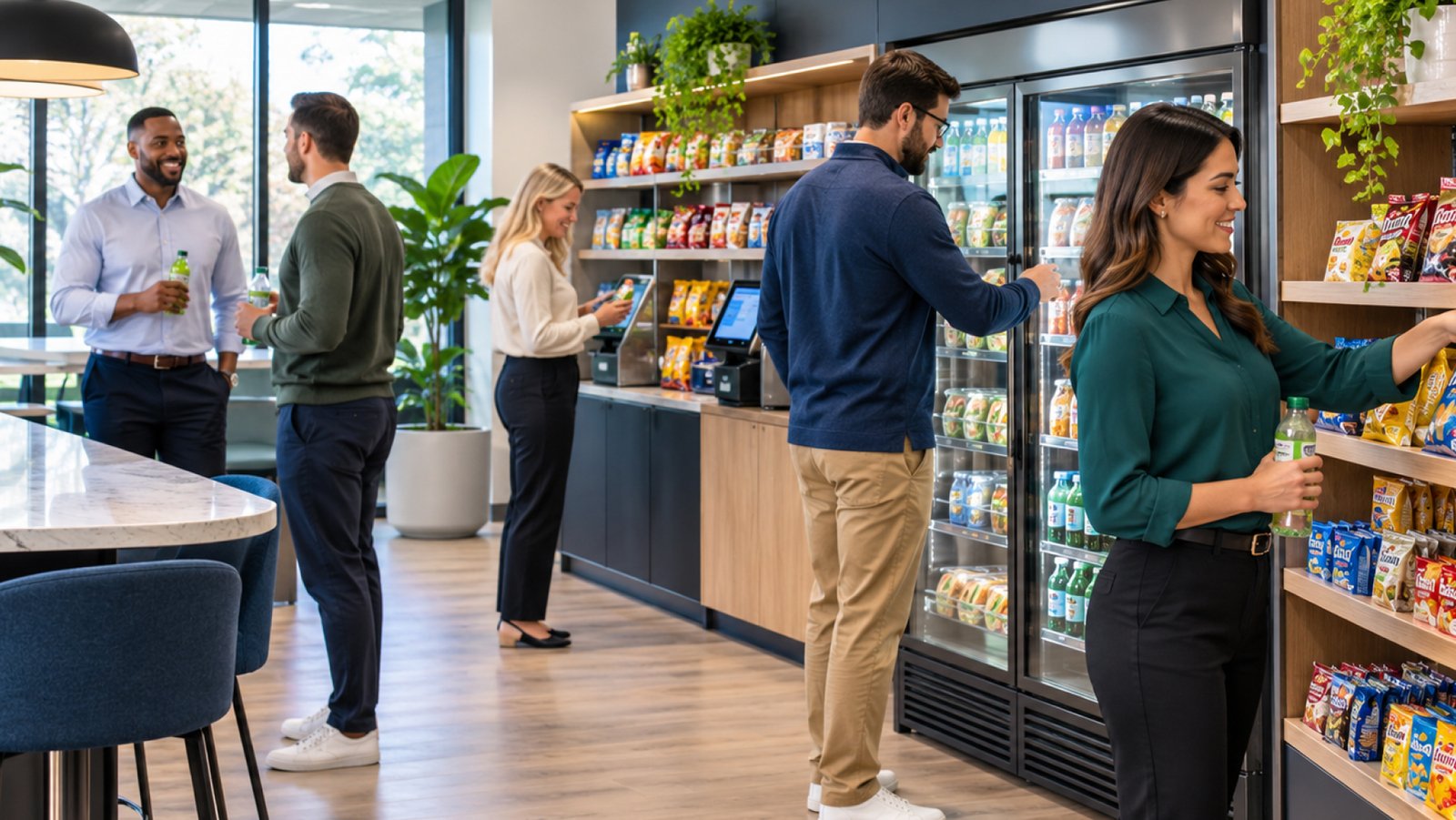
Facility managers often ask whether their team is large enough to justify a vending micro market. Headcount matters, but attendance and purchasing habits matter just as much. A site with 120 people across three shifts may generate steadier demand than one with 300 employees who leave for lunch.
The right number depends on daily attendance, purchasing habits, nearby food options, and available space. This guide covers common benchmarks, practical ways to measure demand, and alternatives to consider before micro-market installation in Memphis, Eastern Arkansas, or North Mississippi.
Why Headcount Matters for a Vending Micro Market
A micro market is an unattended workplace retail space with open shelving and refrigerated displays. Employees browse snacks, drinks, and fresh food before paying at a self-checkout kiosk or another available payment option.
A market needs enough regular shoppers to support inventory turnover and restocking. Low demand can leave fresh products unsold, while high demand can create queues during busy breaks. The useful figure is not simply how many people appear on the company directory. It is how many people are physically present, have time to shop, and are likely to make purchases on a typical workday.
Employee Count Guidelines for a Workplace Micro Market
There is no universal minimum. January Service Company considers businesses with 50 or more employees potential candidates, subject to a site assessment. See its micro market services for details.
A National Council of State Agencies for the Blind micro-market paper discusses approximately 300 building employees and 100 daily customers as reference points, not universal requirements.
These ranges are starting points for discussion, not fixed eligibility rules.
Under 50 Employees
A full open market may be difficult to support, especially when attendance is inconsistent or nearby food options are convenient. Traditional vending or a smart cooler may be more practical because these formats generally require less space and can offer a smaller product selection.
Multiple shifts, regular visitors, and limited nearby food options can improve a smaller location’s potential.
50 to 125 Employees
This range may suit a compact market when employees regularly eat on site. Remote work, off-site lunches, and frequent travel can weaken demand despite a promising payroll headcount.
A site assessment can help determine whether a smaller setup or an open market makes more sense.
More Than 125 Employees
A larger on-site workforce may support more variety, faster product turnover, and additional refrigerated options.
Success still depends on placement, pricing, product selection, and reliable restocking.
What Matters More Than Raw Headcount
Facilities with the same headcount can have very different refreshment needs.
Shift structure: A single day shift creates predictable periods of demand. A manufacturing plant or warehouse operating multiple shifts may generate purchases throughout the day and night. This can make a smaller workforce more attractive, provided restocking covers those shifts and the market remains accessible.
Daily attendance: Hybrid schedules, travel, and remote work can reduce the number of people physically present. Use typical daily attendance rather than total payroll.
Nearby food options: Employees may be less likely to purchase from a market if restaurants, convenience stores, or cafeterias are easy to reach. Facilities with limited nearby options may have more consistent demand, especially when employees have short breaks or cannot leave the site easily.
Break schedules: If everyone takes lunch at the same time, demand may concentrate into a short window. Staggered breaks can spread purchases across the day and reduce congestion. Consider whether the proposed location can handle the busiest periods.
Employee engagement: Employees need to know the market exists and find products they want. Cantaloupe’s guide to micro-market engagement recommends understanding customer preferences, adjusting product selections, and using feedback and promotions to encourage repeat visits.
Options When Your Team Is on the Smaller Side
Smaller workplaces can choose a format that fits their workforce and available space.
A smart store offers compact self-service shopping through secure equipment. Explore January Service Company’s Smart Store solutions when a large open market is impractical.
Traditional vending may suit teams that mainly need packaged snacks and drinks. Workplaces can also combine formats, such as vending near a remote department and a market in the main breakroom.
The best choice is not necessarily the biggest setup. It is the one employees can use conveniently and the provider can maintain consistently.
Space, Power, and Planning Before Installation
Before micro-market installation, check that your facility has room for shelving, refrigerated coolers, and checkout. Keep the market accessible without interfering with production, traffic, or emergency access.
Consider these practical requirements:
- Available space: Employees should browse without blocking walkways, entrances, or emergency exits.
- Electrical access: Refrigerated equipment and checkout systems need suitable power connections.
- Refrigeration: Fresh and chilled products require equipment that maintains appropriate temperatures.
- Restocking access: Delivery and service teams need a convenient route to replenish products without disrupting operations.
- Security and checkout: Discuss payment options, access controls, monitoring, and responsibility for inventory losses with the provider.
A site walkthrough helps confirm the layout and clarify who handles cleaning, equipment issues, and service requests. It is also a chance to discuss employee access, operating hours, and whether the location is convenient for every shift.
How to Test Demand Before You Commit
Use simple checks to assess demand instead of relying on estimates alone.
Survey employees about desired refreshments, shopping times, dietary preferences, price expectations, and whether they currently leave the building for food.
Review existing vending sales to identify popular products and purchasing patterns. Without sales history, observe foot traffic near the proposed breakroom across different shifts. Note how many employees pass through, when breaks occur, and whether the space becomes crowded.
Ask the provider how it estimates customer traffic, restocking frequency, and product quantities.
If you already have traditional vending, our guide on transitioning from vending to a micro market explains how to evaluate an upgrade and plan the change.
When Your Headcount Grows
New hires, added shifts, or expanding departments can change demand and require more capacity or a different product mix.
Ask whether the layout can accommodate expansion. Review sales, stockouts, and employee requests, replacing products that consistently remain unsold. If popular items regularly run out before the next delivery, discuss replenishment frequency and quantities with the provider.
VendingMarketWatch’s coverage of mobile app promotions discusses targeted offers and discounts that can encourage repeat purchases.
Choose a Micro Market That Fits Your Workforce
No employee count guarantees success. January Service Company considers businesses with 50 or more employees potential candidates, while other guidance uses higher benchmarks. Location and daily traffic explain the difference.
Consider attendance, shifts, nearby food options, employee preferences, available space, and service requirements before making a decision. Contact January Service Company for an assessment of your Memphis-area workplace and to discuss refreshment options that fit your workforce.