
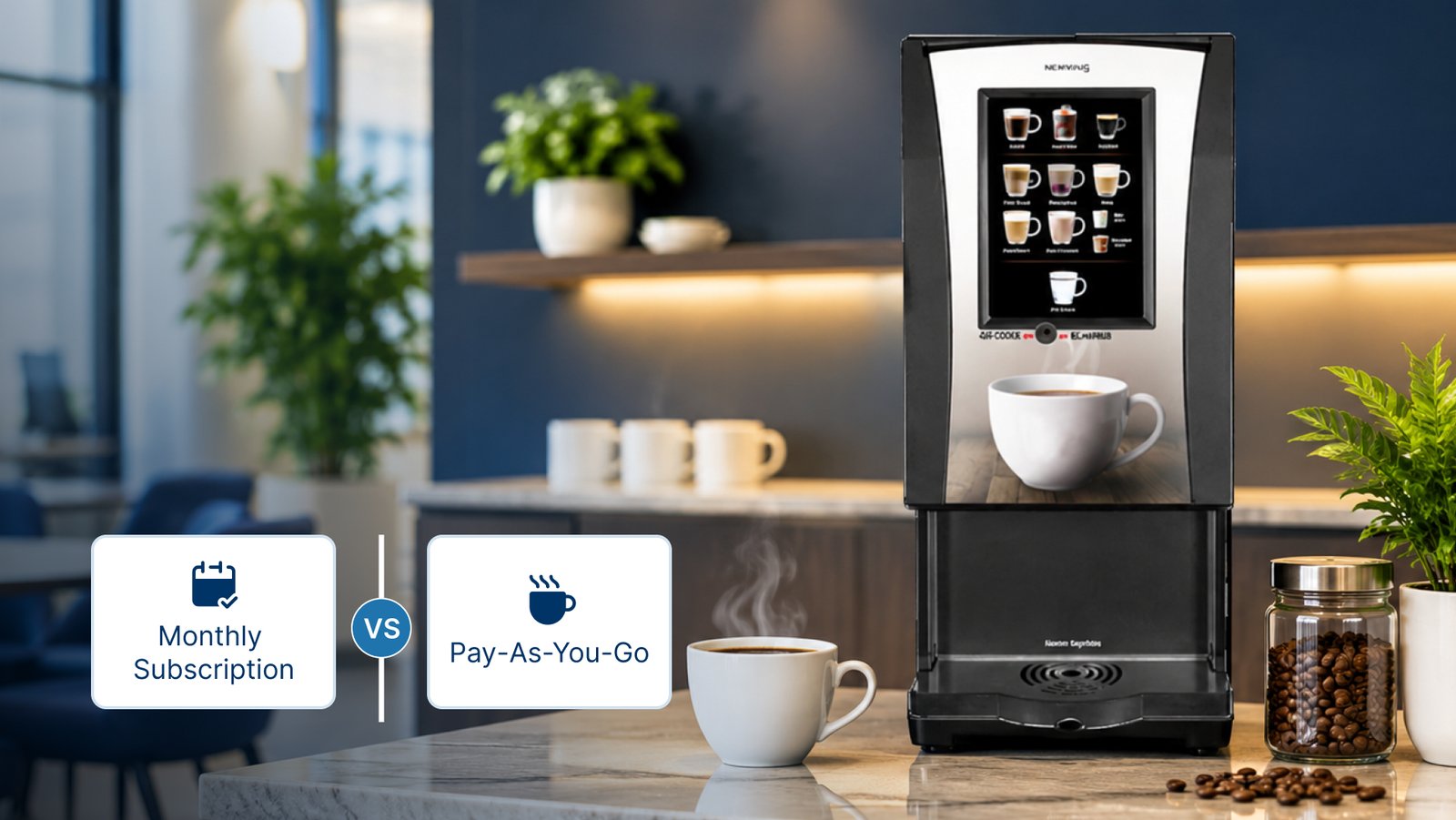
Picture two offices. In one, the coffee bill arrives on the same day every month. In the other, someone orders supply whenever stocks run low, so spending changes from month to month.
An office coffee subscription offers recurring service and payment. Pay-as-you-go lets you purchase supplies as needed. Neither is automatically cheaper. The right choice depends on coffee consumption, attendance, and what the provider includes. Harvard Business School’s discussion of subscription fees makes a useful point: recurring payments work best when pricing and service match customers’ needs.
Key Takeaways
- Subscriptions can make monthly spending easier to plan.
- Pay-as-you-go gives more control over order timing and quantities.
- Equipment, delivery, supplies, and maintenance affect the total cost.
- Compare contract terms and actual coffee use before choosing.
What Is an Office Coffee Subscription?
An office coffee subscription is a recurring arrangement in which a provider supplies coffee and depending on the plan, equipment, accessories, and maintenance for an agreed fee. Deliveries may follow a set schedule, while quantities and product choices vary by contract.
Some plans bundle beans, cups, creamers, and machine servicing. Others charge separately for equipment, delivery, or products. Ask for an itemized quote rather than assuming every subscription includes the same services.
The main advantage is predictability: a recurring fee can simplify budgeting and reduce ordering tasks. However, it may not offer good value if attendance drops. Check whether you can change quantities, pause deliveries, or upgrade your plan as your team’s needs change.
How Does Pay-As-You-Go Office Coffee Work?
With pay-as-you-go, your business orders coffee, supplies, or service when needed and pays for each purchase or visit. There may be no recurring service fee, but this depends on the provider’s arrangement. Some still require equipment rental, minimum orders, or service agreements.
This approach can suit small teams, offices with irregular attendance, or businesses testing a coffee station. You can adjust orders as usage changes and avoid buying supplies you do not need.
The trade-off is variable spending and more administration. Someone must monitor inventory, place orders, and arrange repairs if those tasks are not included. Late orders can leave employees without coffee, while frequent small orders may increase delivery costs.
Office Coffee Service Cost: What Really Drives the Price?
Your office coffee service cost depends on several factors: employee count, cups consumed per day, coffee type, machine choice, delivery frequency, and the level of support included. Specialty beans and bean-to-cup equipment generally cost more than a basic brewer and standard ground coffee.
Ask providers to separate recurring fees from variable charges. Check whether the quote includes equipment rental or purchase, installation, coffee, cups, filters, milk or creamer, cleaning supplies, delivery, maintenance, and emergency repairs. Also ask about minimum orders, price increases, and early termination fees.
Coffee prices can change, too. The U.S. Bureau of Labor Statistics average-price series published through FRED recorded ground coffee at about $9.25 per pound in October 2026. This is a U.S. consumer price for ground coffee, not a wholesale bean price or a direct estimate of what an office will pay. It does, however, show why supply costs deserve attention when comparing longer-term agreements.
A subscription may offer a negotiated rate for a defined period but check for escalation clauses and renewal terms. Pay-as-you-go orders may reflect current supplier pricing, although volume discounts may still be available.
Why Coffee Price Changes Matter
A 2007 U.S. Department of Agriculture study found that a 10-cent increase in green coffee bean costs was associated with an average 2-cent increase in manufacturer and retail prices in the same quarter. Persistent cost changes were passed through more fully over time.
This historical study is not a forecast of current office coffee prices. It shows that commodity cost changes may reach customers gradually, so ask providers how and when they can adjust prices.
Subscription vs. Pay-As-You-Go: Which Fits Your Office?
A subscription may suit an office with steady attendance and regular coffee consumption. It can reduce ordering tasks and make expenses easier to forecast when contract terms are clear.
Pay-as-you-go may suit a small team, seasonal workplace, or office with changing attendance. It offers control over purchase timing, but someone must track stock and prices.
A hybrid arrangement is another option: keep a service plan for equipment or maintenance, then order coffee and supplies according to use. Ask about adjustable quantities and flexible billing.
Before deciding, calculate the cost per cup: add monthly fees, supplies, delivery, and service charges, then divide by the number of cups your team actually drinks. This can reveal whether a low monthly fee or product price is misleading.
Our guide to the ROI of office coffee services explains other factors to consider when evaluating a workplace coffee program.
Do Bean-to-Cup Coffee Machines Change the Math?
Bean-to-cup coffee machines grind whole beans for each drink and can prepare espresso, lattes, and regular coffee. They offer variety and brew individual drinks on demand, which may reduce leftover brewed coffee. However, they require regular cleaning, maintenance, and replenishment.
Equipment and service can cost more than a basic brewer. Some providers include the machine in a managed subscription; others charge separately for rental, supplies, or repairs. Ask who covers parts, cleaning, and breakdowns.
Pay-as-you-go can still work, but compare the total cost of equipment, beans, and service—not just the price per bag. Also consider how many employees will use the machine during busy periods. A machine that cannot keep up with demand may create queues and reduce the convenience of having coffee available.
How to Compare Office Coffee Service Providers
When comparing office coffee service providers, look beyond the advertised monthly price. Ask about local repair response times, delivery frequency, and whether you can change products or quantities.
Check contract length, renewal rules, cancellation fees, minimum orders, and price-adjustment terms. Confirm whether cleaning, preventive maintenance, and emergency repairs are included.
Consider employee preferences, too. Your team may want regular and decaf coffee, tea, or specialty options. Choose a provider that can adjust the selection as needs change.
If you also need snacks and other breakroom essentials, a pantry service may let one provider coordinate coffee, snacks, and supplies.
Why Choose January Service Company?
January Service Company has served Memphis-area workplaces since 1982, offering office coffee, vending, micro-markets, smart stores, water, and pantry programs. Its team can help compare equipment, products, and service options for your workplace.
Explore January Service Company’s office coffee service to learn about available options and discuss a setup for your team.
Choose the Pricing Model That Fits Your Team
An office coffee subscription can make spending and restocking easier to plan. Pay-as-you-go can offer flexibility when consumption is low or unpredictable. Neither option wins in every workplace.
Estimate how much coffee your team uses, list the services you need, and compare complete quotes. Pay attention to price changes, contract terms, equipment costs, and who handles maintenance. Review the arrangement when your headcount or attendance changes.
The best model is the one that delivers the coffee your employees want without paying for services or supplies your office does not use.