Most offices only think about their water when something goes wrong. The cooler tastes unusual, employees notice an odor, or the breakroom goes through cases of bottled water every week. An office water filtration system can address some of these concerns, but choosing the right one requires understanding what the equipment actually does.
Water filtration is not a one-size-fits-all process. Different filters target different substances, and a system that makes sense for one workplace may be unnecessary for another. The goal is to understand the existing water, match the treatment to a specific need, and choose equipment that can handle everyday workplace demand.
How Water Filtration Works
At a basic level, filtration passes water through materials or membranes designed to reduce particular substances. What gets removed depends on the filter and its certification.
Many systems use more than one stage. A sediment filter may capture larger particles and protect the filters that follow. Activated carbon can then reduce certain compounds that affect taste and odor. More specialized systems may use fine membranes or additional treatment stages when a different level of filtration is required.
Simply seeing the word “filtered” on a dispenser does not explain what the equipment reduces. Businesses should ask for the system’s specific performance claims and certification information.
The source water matters too. The U.S. Environmental Protection Agency’s filtration guidance recommends understanding filtration options before selecting equipment. Reviewing the building’s water-quality information gives a provider something concrete to work from instead of automatically recommending the most complicated system.
Main Filtration Technologies
The differences between filtration technologies become important when businesses compare equipment.
Sediment Filtration
Sediment filters capture particles such as dirt, rust, and debris. They are often used as an early stage that protects later filters and system components.
Activated Carbon
Activated carbon is common in drinking-water systems because it can reduce certain substances that affect taste and odor. Its exact performance depends on the filter design and certification.
Reverse Osmosis
Reverse osmosis forces water through a membrane that can reduce certain chemicals and germs, depending on the equipment. However, that does not automatically make it the best choice for every office.
The CDC’s guidance on choosing water filters explains that filters perform different functions and should be selected according to what needs to be removed. The CDC also advises users to check certifications and follow maintenance instructions.
Certification should correspond to a specific reduction claim rather than being treated as a general quality badge. Businesses should ask what standard applies, what the filter is certified to reduce, and whether that matches their actual concern.
Plumbed-In vs. Point-of-Use Systems
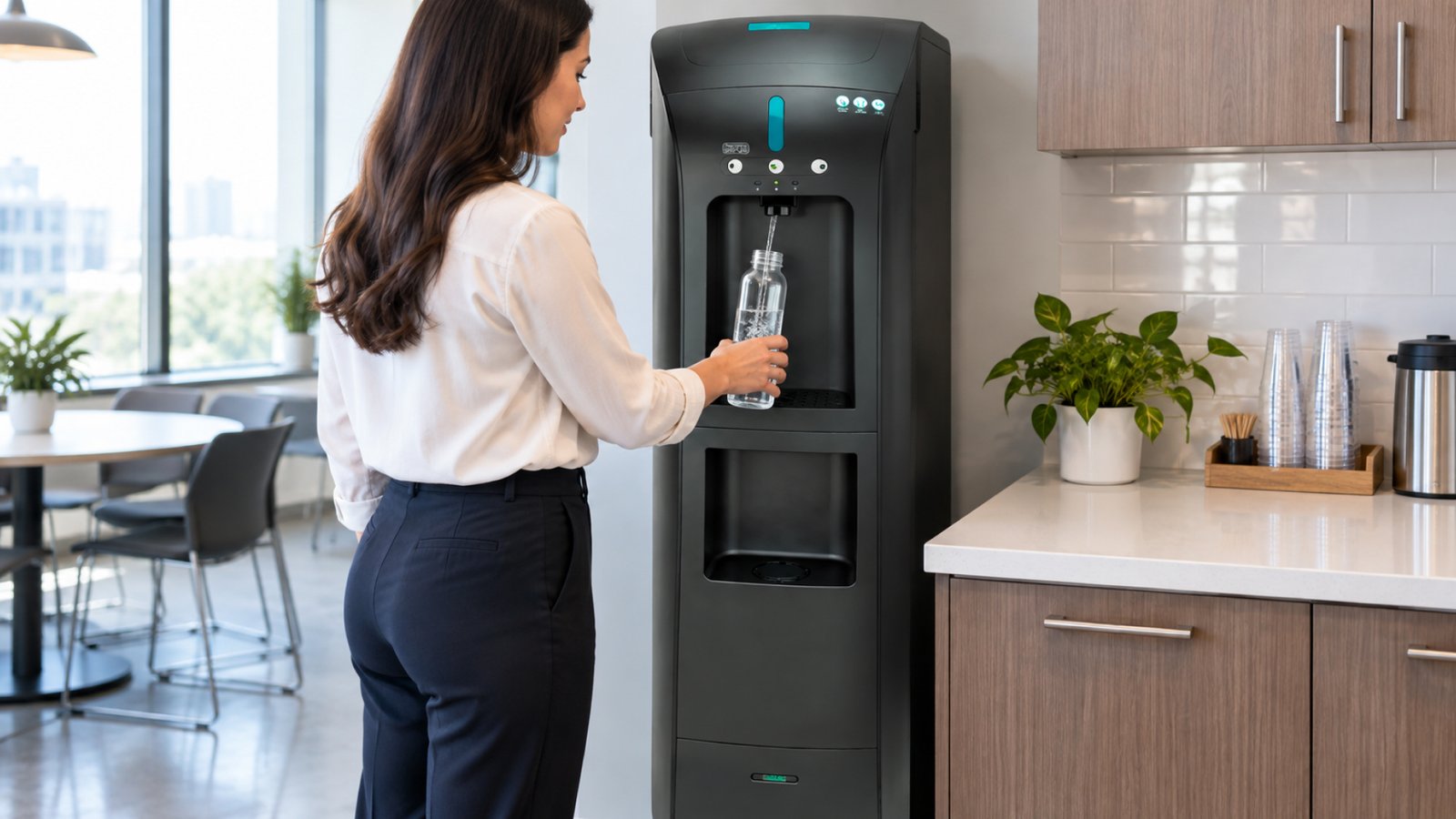
A plumbed-in water filter connects directly to the building’s supply and feeds a dispenser or another drinking-water outlet. Because water arrives continuously through the line, staff do not need to replace large bottles throughout the week.
Point-of-use filtration treats water at a specific location. This may include an under-sink filter or a system serving one breakroom or drinking station.
The right choice depends on workplace size and layout. A small office with one breakroom has different requirements from a multi-floor facility where hundreds of employees need water throughout the day.
Maintenance should be part of the decision. Filters must be changed according to manufacturer instructions, and neglected equipment can become less effective. Businesses comparing setups can review JSC’s guide to portable versus plumbed water coolers for a closer look at practical differences.
Why Workplace Hydration Matters
An office water filtration system cannot make employees drink water, but convenient access can make hydration easier during a busy workday.
It is important not to exaggerate productivity research. A systematic review indexed by PubMed examined 33 studies with 3,636 adults and found little consistency across executive-function outcomes. Roughly half reported unclear or neutral effects, while the other half found effects in areas such as working memory, inhibitory control, and attention. The researchers called for more consistent and longer-term studies.
The practical case for workplace water does not need an inflated productivity promise. Giving employees convenient access to drinking water is useful on its own, and a managed filtration system can provide that access without relying on repeated bottled-water deliveries.
Planning Office Water Access
For some workplaces, one dispenser is enough. Others need filtered taps, bottle-filling stations, or several drinking points near the areas employees actually use.
Capacity and placement matter as much as filtration technology. One high-capacity unit in an inconvenient location may be less useful than smaller systems placed near busy work areas. Facilities operating multiple shifts should also consider peak demand and whether employees can reach water during short breaks.
Equipment monitoring may support maintenance by helping providers identify service needs. January Service Company’s technology solutions show how connected systems can support modern workplace refreshment equipment. Technology should serve a clear purpose, such as improving reliability or maintenance, rather than being added for its own sake.
Choosing Water Filtration Services
Choosing water filtration services involves more than comparing dispensers. Ask the provider:
- What does each filtration stage reduce?
- Why is this system appropriate for the building’s water?
- Is the equipment certified for the relevant claims?
- Who replaces filters and services the dispenser?
- How is the maintenance schedule determined?
- Can the system handle peak demand?
- What plumbing, drainage, power, and space are required?
- What ongoing service or replacement costs apply?
A dependable provider should explain the recommendation in plain language. Vague promises of “cleaner” water are less useful than specific information about treatment, capacity, installation, and maintenance.
Common Filtration Mistakes
One common mistake is choosing equipment before identifying the actual goal. A filter intended mainly to improve taste is different from one certified to reduce a particular contaminant.
Another is forgetting maintenance after installation. Replacement intervals vary according to equipment, water conditions, usage, and manufacturer specifications.
Cost comparisons can also be misleading when they focus only on the initial price. Installation, replacement filters, servicing, and recurring requirements all contribute to the long-term cost.
Finally, think about accessibility. A filtration system provides limited value if employees cannot conveniently reach it during their breaks.
Why Choose January Service Company?
January Service Company has served Memphis-area workplaces since 1982. Its water filtration services include installation and ongoing support, giving businesses a managed option instead of leaving internal teams responsible for the equipment alone.
JSC can consider workforce size, building layout, demand, and service needs when recommending a workplace water setup. Local support also gives businesses a clear contact when filters need replacement or equipment requires attention.
Choose a System That Fits the Workplace
A good office water filtration system should work quietly in the background. Employees receive convenient access to drinking water, facility teams understand the maintenance schedule, and the business is not constantly troubleshooting equipment or arranging bottle deliveries.
Start with the existing water and decide what filtration needs to accomplish. Then compare treatment technology, certification, capacity, installation, maintenance, placement, and ongoing costs.
Ready to improve water access in your Memphis workplace? Talk with January Service Company about a filtration setup designed around your building and workforce.