
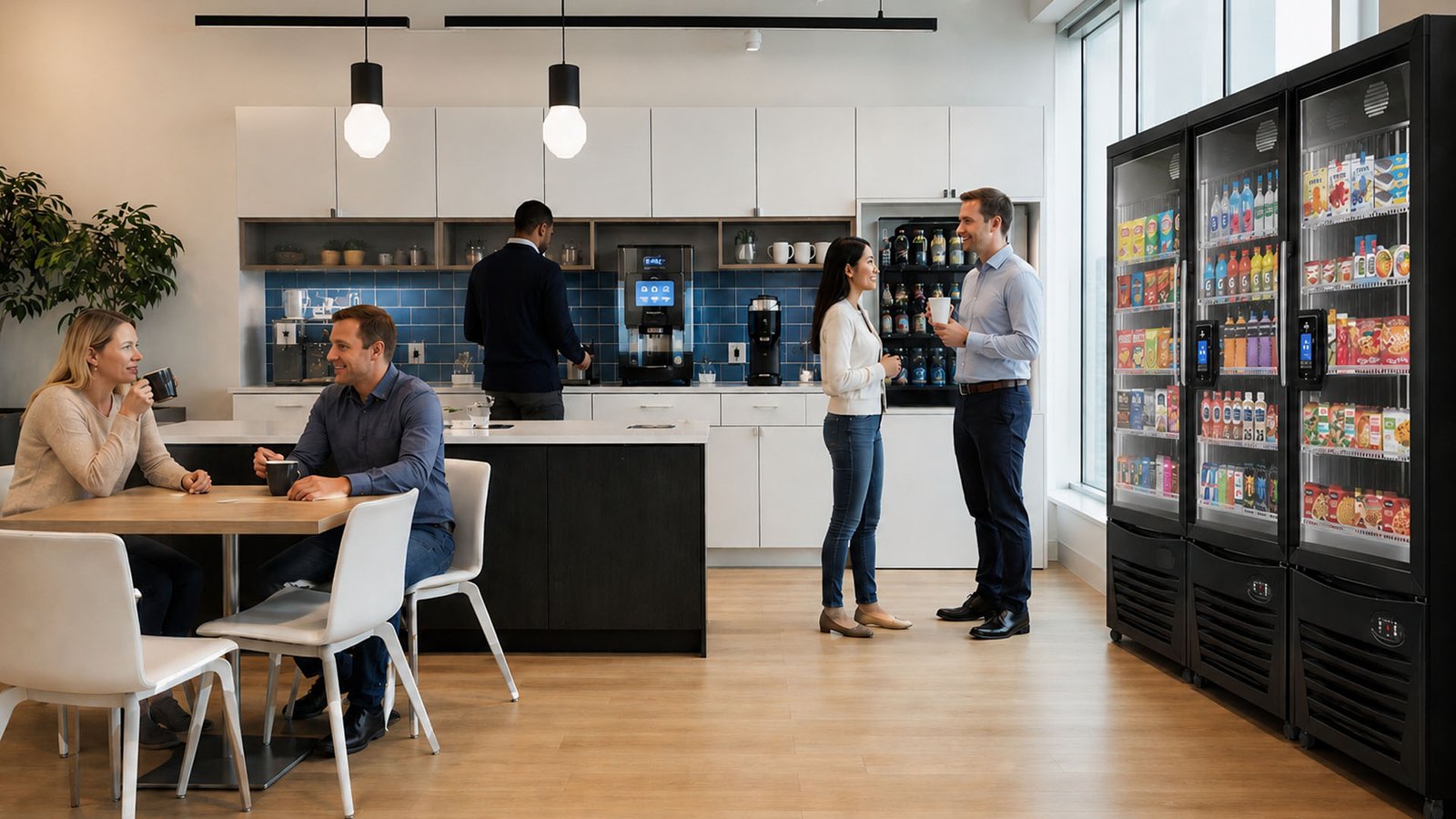
Every office breakroom starts the same way. It might start with a coffee pot, a mini fridge, and a basket of snacks from the latest supply run. It works fine at first. Then the team grows. Employees ask for more variety. That same coworker gets tired of restocking the fridge every week. At some point, informal breakroom management stops scaling. Businesses have to decide how much actual breakroom vending service they need.
This question is harder than it sounds. Too little service leaves employees staring at empty shelves and stale options. Too much service creates cost for a team that never touches half of what gets stocked. The right answer depends on a handful of concrete factors, not guesswork. Most businesses can figure it out by working through a few practical questions.
Start With Headcount and Foot Traffic
Employee count is the most obvious starting point, but it isn’t the only variable that matters. A 15-person office has different needs from a 60-person hybrid workplace. If half the team works remotely, daily breakroom traffic can change significantly. Actual foot traffic through the breakroom matters more than the number on the org chart.
Smaller teams, generally under 25 people, tend to do well with a single vending machine or a compact office coffee service paired with a small snack selection. Mid-sized offices, somewhere between 25 and 75 employees, usually need a full vending setup alongside dedicated coffee equipment. A single machine can’t keep pace with demand during peak hours. If your team is outgrowing its current coffee setup, our earlier piece on office coffee station ideas walks through layout and equipment choices that scale as headcount grows. Once a business crosses roughly 50 to 75 employees on-site regularly, a self-serve micromarket often becomes the more practical option. It offers far more variety without requiring a wall of separate machines.
Factor In What Employees Actually Want
Breakroom service isn’t just about volume. It’s about matching what gets stocked to what people actually eat and drink. A workforce heavy on health-conscious employees will burn through healthy snacks fast and leave sugary options untouched. That mismatch wastes money on a product nobody wants. The opposite is true for a younger, more casual workforce that treats the breakroom as a quick energy stop between tasks.
This is where a good provider earns its value. Ask whether the company tracks sales data by machine. Find out if it adjusts the product mix based on those results. Office refreshment services should respond to actual consumption patterns. This can provide better value than a generic, one-size-fits-all setup. It also helps to think about coffee separately from snacks, since coffee habits vary widely by team. Our coffee service page breaks down equipment options for teams that want a dedicated setup beyond a basic pot.
Consider the Role of Breaks in Daily Operations
Breakroom access ties directly into how employees experience their workday. Federal labor guidance offers a useful lens here. The Fair Labor Standards Act treats certain short breaks as compensable work time. The U.S. Department of Labor explains the distinction in its guidance on breaks and meal periods. That detail matters more than it seems. When employees have limited break time, convenient access to food and drinks can help them make better use of that time.
A breakroom that runs dry forces employees to spend their limited break time elsewhere. That shrinks the actual rest and recovery those minutes were meant to provide. Scaling service appropriately isn’t just about convenience. It supports the intended purpose of the break itself.
Think About Breakroom Service as Part of Workplace Wellbeing
Breakroom decisions increasingly connect to broader employee wellbeing strategy, not just convenience. The CDC’s workplace health promotion framework supports a coordinated approach to employee health. It notes that effective programs can improve workplace outcomes and support employee wellbeing. A breakroom stocked exclusively with vending staples sends a very different message than one that includes water, fresh options, and a real coffee setup employees enjoy using.
This doesn’t mean every office needs an elaborate wellness program built around snacks. It means the breakroom is one of the more visible, daily touchpoints where a business can signal that employee comfort matters. Getting the scale right makes that signal land the way it’s intended.
Benefits Data Backs Up the Trend
Workplace benefits research shows that employers invest in more than healthcare and retirement. Smaller perks can also shape the daily employee experience. SHRM’s ongoing Employee Benefits Survey tracks this shift across hundreds of benefit categories every year. It reflects how much emphasis employers now place on smaller, everyday improvements to the workplace. Breakroom quality fits squarely into that category. It rarely decides a job offer on its own, but it shapes day-to-day satisfaction in a way that compounds over time.
How to Right-Size Your Service
A few practical steps make this decision easier. Track actual usage for a month before committing to a bigger setup. Guessing at demand usually leads to overbuying or underbuying. Separate coffee planning from snack and drink planning, since the two often follow very different usage patterns. Revisit the setup when headcount changes significantly. Don’t wait until complaints start piling up.
For businesses trying to figure out where to start, our vending services page breaks down what a standard setup looks like for different office sizes.
A Quick Way to Think About Sizing
Business owners weighing this decision can ask a short set of questions to land on the right scale. How many people are actually in the building on a typical day, not just on payroll? Does the team lean toward healthy snacks or more indulgent options? Does that even out, or point clearly in one direction? Is coffee a daily habit for most of the team, or a smaller subset? Answering these honestly, even informally, usually points toward the right starting setup faster than comparing packages side by side.
It’s also worth revisiting these questions after any major shift, not just growth. A move to a larger office, a new hybrid schedule, or a seasonal change in staffing can all change what the breakroom actually needs to support. Locking into one setup indefinitely, without checking whether it still fits, is one of the more common ways businesses end up overpaying or underserving their team.
Getting the Balance Right
There’s no universal formula for how much breakroom service a business needs, but there is a reliable process for figuring it out. Start with headcount and actual foot traffic. Layer in what your specific team eats and drinks. Factor in how breaks function within your workday. Think about the breakroom as part of a broader effort to support employee wellbeing, not a standalone expense.
Businesses that treat this as a one-time setup decision can overspend on unused equipment. They may also underserve a growing team. Businesses that revisit it periodically, based on real usage rather than assumptions, tend to get the balance right and keep employees satisfied without wasting budget on the wrong scale of service.