
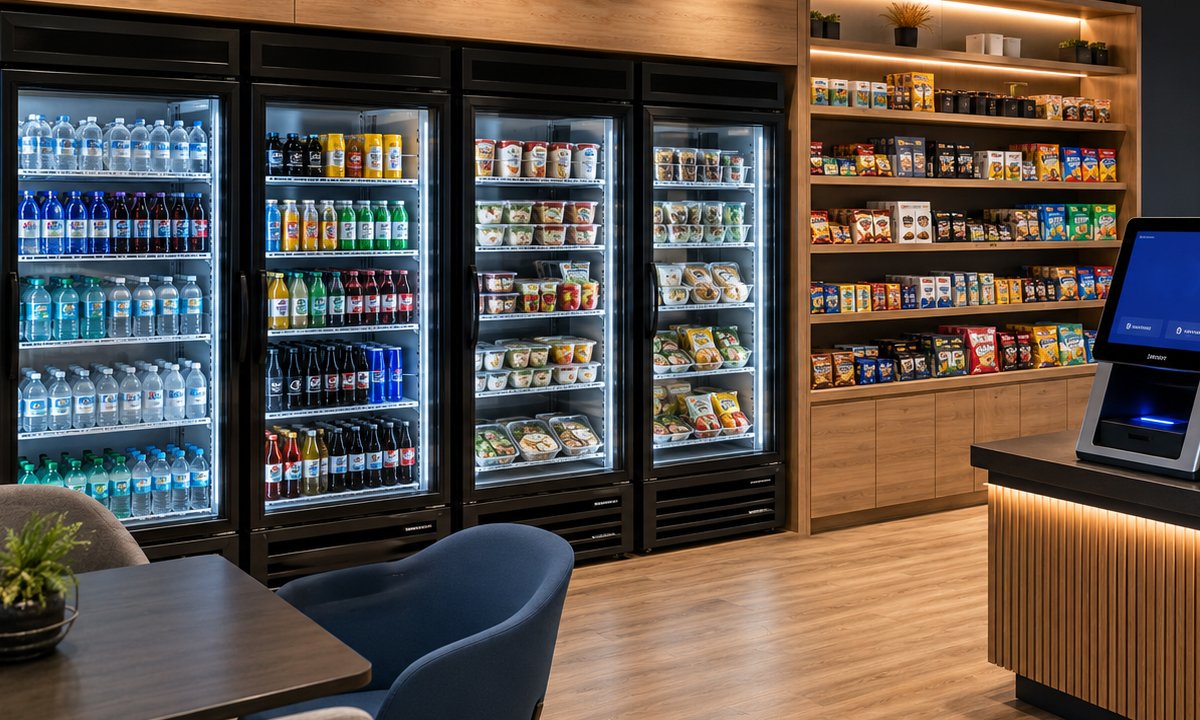
Breakrooms often become the busiest areas in an office during lunch hours and scheduled breaks. In manufacturing plants, corporate campuses, healthcare facilities, and distribution centers, hundreds of employees may visit the refreshment area within a short period. Traditional vending machines and staffed cafeterias frequently struggle to keep up with this sudden demand, leading to long lines, delayed purchases, and lost productivity.
Modern smart stores solve this challenge by combining self-service shopping, artificial intelligence, and automated retail technology. Instead of requiring additional employees to manage transactions during busy periods, these stores allow multiple people to shop simultaneously while maintaining accurate inventory and secure payment processing.
Organizations investing in workplace retail technology are discovering that smart stores not only improve convenience but also streamline retail operations, reduce waiting times, and create a better overall employee experience.
Why Break-Time Traffic Is a Challenge
Peak break periods create unique operational challenges because large groups of employees often arrive at the same time. Traditional vending machines typically serve one customer per transaction, while cafeterias require cashiers and food service staff to process purchases efficiently.
As workforces grow, these limitations become more noticeable. Long queues reduce valuable break time, frustrate employees, and sometimes discourage people from purchasing refreshments altogether.
Modern organizations are addressing these issues by implementing ai smart stores, which provide a frictionless shopping experience where employees can enter, select products, complete purchases quickly, and return to work without waiting for manual assistance.
Benefits of Smart Stores During Peak Break Hours
- Allow multiple employees to shop simultaneously.
- Reduce waiting times through self-service checkout.
- Improve queue management without increasing labor costs.
- Support touchless technology and secure digital payments.
- Provide real-time inventory monitoring for consistent product availability.
- Enhance operational efficiency while improving employee satisfaction.
These advantages make smart stores an effective solution for organizations with high employee traffic throughout the day.
AI Improves Retail Operations Behind the Scenes
The efficiency of modern smart stores depends heavily on intelligent software that continuously monitors store activity. Advanced sensors, connected devices, and cloud-based platforms work together to track purchases, monitor inventory levels, and support automated replenishment.
According to insights from IBM, demand forecasting helps businesses anticipate purchasing behavior by analyzing historical and real-time data. Smart stores apply similar principles to predict product demand during busy periods, helping operators prepare inventory before shortages occur.
Organizations using advanced ai workplace technology can monitor performance remotely while making data-driven decisions that improve efficiency across multiple locations.
What Is a Contactless Payment?
One question many organizations ask when adopting automated retail is what is a contactless payment and why it matters during busy periods.
A contactless payment allows customers to complete purchases by tapping a credit card, smartphone, smartwatch, or another enabled device instead of inserting a card or handling cash. Because transactions are completed in only a few seconds, checkout becomes significantly faster than traditional payment methods.
For workplaces experiencing heavy break-time traffic, faster transactions reduce congestion while allowing more employees to purchase refreshments within the same time period. Combined with self-service checkout, contactless payments create a smoother shopping experience that minimizes delays without requiring additional staff members.
Businesses searching for vending services in Memphis increasingly prioritize providers that offer contactless payment technology alongside intelligent retail solutions to improve convenience, reduce queues, and enhance the overall employee experience.
Inventory Management Keeps Products Available
Even the most advanced smart store cannot deliver a great customer experience if popular products are frequently out of stock. This is why effective inventory management is one of the most important components of modern automated retail. AI-powered systems continuously monitor product movement, helping operators understand purchasing trends and restock items before shortages occur.
According to Investopedia, inventory management helps businesses maintain the right balance between product availability and operational efficiency. Smart stores use this principle by combining automated tracking with real-time reporting, allowing managers to make informed inventory decisions instead of relying on manual stock checks.
By keeping shelves consistently stocked, organizations improve employee satisfaction while reducing missed sales during peak break periods.
Features That Help Smart Stores Handle High Traffic
- AI-powered inventory monitoring and automated replenishment alerts.
- Multiple self-service checkout options for faster transactions.
- Touchless payment technology that minimizes waiting time.
- Real-time sales reporting and performance analytics.
- Cloud-based management for multiple workplace locations.
- Flexible layouts that support smooth customer movement.
These capabilities help organizations manage heavy traffic efficiently while maintaining accurate inventory and reducing operational workloads.
Artificial Intelligence Enhances the Shopping Experience
Modern AI powered retail solutions do far more than automate transactions. Artificial intelligence analyzes purchasing behavior, identifies product trends, and supports continuous operational improvements. Instead of reacting to problems after they occur, smart stores can anticipate demand and maintain a consistent shopping experience throughout the day.
According to Encyclopaedia Britannica, artificial intelligence enables computer systems to perform tasks that typically require human intelligence, including learning from data and making informed decisions. In workplace retail environments, AI supports smarter inventory planning, improves forecasting accuracy, and helps operators optimize product selection.
These capabilities are especially valuable in facilities where employee traffic changes throughout the day, allowing refreshment programs to remain efficient without increasing staffing requirements.
Building a More Efficient Workplace Retail Environment
Organizations experiencing rapid growth need retail solutions that can scale alongside their workforce. Smart stores provide that flexibility by supporting larger product selections, automated inventory management, and seamless payment experiences without significantly increasing operating costs.
Businesses exploring workplace retail solutions or modern vending services in Memphis often discover that smart stores deliver greater long-term value than relying solely on traditional vending equipment. By combining automation, analytics, self-service technology, and intelligent inventory management, these solutions help organizations improve convenience, streamline retail operations, and adapt more effectively as employee demand grows.
For a deeper understanding of how intelligent workplace retail continues to evolve, explore our guide on Beyond Vending: Smart Store Technology. It explains how connected retail systems, AI, and automation are transforming workplace refreshment experiences and helping organizations deliver greater convenience with fewer operational challenges.
Organizations exploring modern vending solutions in Memphis should evaluate providers based on technology integration, inventory visibility, and long-term service support in addition to the equipment they offer. These factors often contribute more to long-term operational success than the equipment alone.
Conclusion
As workplaces become larger and employee expectations continue to evolve, smart stores are helping organizations manage peak break-time traffic more efficiently than traditional retail models. By combining smart retail solutions, intelligent inventory management, queue management, touchless technology, and AI powered retail, businesses can provide a fast, convenient shopping experience without hiring additional staff.
These innovations not only improve retail operations but also reduce waiting times, maintain product availability, and support a more productive workplace. Whether serving corporate offices, manufacturing facilities, healthcare organizations, or educational campuses, smart stores deliver scalable solutions that meet the demands of today’s workforce.
Organizations investing in modern workplace retail technology are building refreshment programs that are prepared for future growth while creating a better experience for employees every day.