
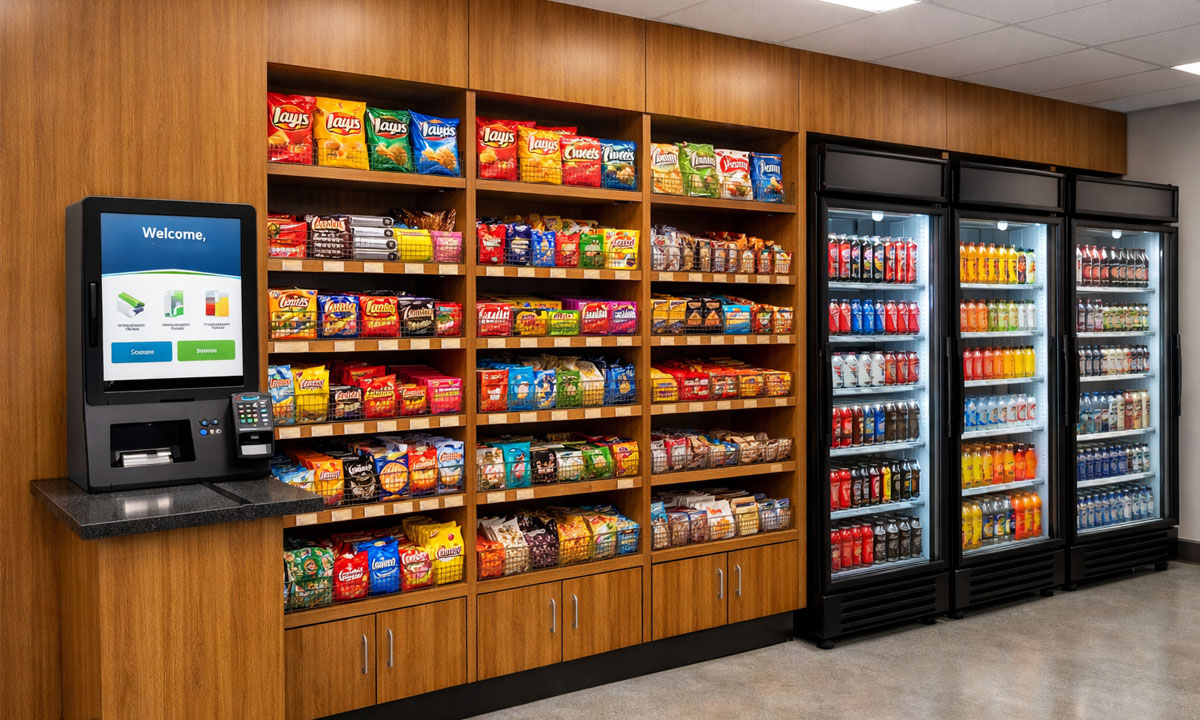
Large facilities operate on scale. Whether it is a manufacturing plant, hospital campus, distribution hub, or multi-building corporate environment, providing convenient food access is not just a perk. It is an operational necessity.
Traditional vending machines often lack variety and capacity. Full-service cafeterias can be costly to operate and difficult to justify in every location. Micro Markets offer a practical middle ground. They provide self-serve access to fresh food, beverages, and snacks inside the facility, operating without the overhead of full kitchen staffing.
In large facilities, micro markets function as structured, unattended retail environments designed to support efficiency, convenience, and workforce satisfaction.
Why Large Facilities Are Turning to Micro Markets
As organizations grow, breakroom needs become more complex. Hundreds or even thousands of employees may need access to food across multiple shifts. Off-site food runs reduce productivity and increase downtime. Limited cafeteria hours fail to support overnight teams.
Micro markets address these operational gaps.
Industry discussions on how micro markets support day-to-day building operations highlight their ability to reduce congestion, streamline employee flow, and support facility management goals.
Instead of relying on rigid schedules or limited product selections, micro markets allow facilities to offer flexible, always-available food options within the building.
Organizations implementing structured workplace refreshment programs often partner with professional micro market service providers to handle installation, stocking, and ongoing management.
How Micro Markets Function Within Large Facilities
In large environments, micro markets are typically placed in centralized break areas or high-traffic zones. They operate on self-checkout systems that record transactions digitally. This allows real-time inventory monitoring and usage tracking.
Unlike traditional vending, micro markets offer expanded product variety, including:
- Fresh meals and salads
- Refrigerated beverages
- Healthy snacks
- Convenience pantry items
The broader retail format gives facilities greater flexibility in product assortment and portion sizes.
The retail concept itself is part of a broader unattended merchandising evolution, as described in the Wikipedia overview of Micromarket retail systems.
Benefits of Micro Markets in Large Facilities
Increased Accessibility Across Shifts
Large facilities often operate 24 hours a day. Micro markets provide consistent access regardless of shift schedules. Employees working overnight or rotating shifts have the same food access as daytime teams.
Improved Employee Satisfaction
Modern workplaces are placing greater emphasis on breakroom experience. Industry analysis on the shift toward smart retail micro markets and custom breakrooms shows that companies are investing in upgraded workplace amenities to improve morale and retention.
A well-stocked micro market signals investment in employee comfort and convenience.
Reduced Operational Downtime
When employees leave the facility for meals, time is lost in transit, parking, and re-entry. Micro markets eliminate this inefficiency by keeping food access onsite.
In secure or high-volume environments, this reduction in external traffic improves workflow continuity.
Lower Overhead Compared to Cafeterias
Cafeterias require kitchen equipment, culinary staff, and maintenance. Micro markets operate without those fixed costs, making them financially efficient for large facilities that need consistent food access without full-scale foodservice infrastructure.
Data-Driven Inventory Management
Digital transaction systems allow operators to monitor purchasing patterns and adjust stock accordingly. This reduces waste and ensures popular items remain available.
For facilities exploring more advanced automation, solutions such as smart store technology provide additional layers of tracking and access control.
Integrating Micro Markets Into a Broader Workplace Strategy
Micro markets are most effective when integrated into a larger breakroom ecosystem. Some facilities supplement retail access with employer-sponsored offerings or structured refreshment programs.
For example, pairing retail-based purchasing with managed pantry service programs allows companies to balance employee perks with controlled inventory management.
This hybrid model supports both operational efficiency and workforce satisfaction.
Scalability for Expanding Facilities
As facilities grow, micro markets can scale alongside them. Additional shelving, coolers, or checkout stations can be added without redesigning the entire breakroom.
This flexibility makes micro markets particularly valuable for expanding manufacturing plants, hospital systems, and corporate campuses experiencing workforce growth.
Supporting Facility Management Goals
Beyond employee convenience, micro markets support broader facility management objectives. They reduce offsite traffic, centralize food access, and provide measurable data on consumption patterns.
Facility managers benefit from predictable restocking schedules, inventory transparency, and structured oversight.
In large environments where operational efficiency is critical, these systems become part of the building’s infrastructure rather than just an amenity.
Final Thoughts
Micro Markets provide large facilities with a scalable, efficient, and employee-focused food access solution. By offering expanded variety, self-serve convenience, and digital inventory tracking, they bridge the gap between vending machines and full-service cafeterias.
For organizations managing high employee volume, multiple shifts, and operational complexity, micro markets deliver consistent access without excessive overhead. When professionally managed and strategically integrated, they become a central component of both workplace experience and facility efficiency.